• NEWS
  • ABOUT
    • Bio
    • DMG
    • Beleza!
    • Awards
    • Commissions
    • Louie! Louie! Louie!
  • MUSIC
    • DM Radio
  • EDUCATION
    • Lessons
    • Classes
    • Workshops
  • TOUR
    • Tour Support
    • Touring History
  • BLOG
  • MEDIA
    • Radio
    • Videos
    • Press Kit
    • Reviews
    • Interviews
    • Newsletters
    • Quotes
  • DISCOGRAPHY
    • 2022 Cascadia
    • 2016 Jazz Noir
    • 2014 Sagebrush Rebellion
    • 2010 Grant & Matheny
    • 2008 Best of Dmitri Matheny
    • 2007 Spiritu Sancto
    • 2006 The SnowCat
    • 2005 Nocturne
    • 2000 Santa's Got a Brand New Bag
    • 1998 Starlight Cafe
    • 1996 Penumbra
    • 1995 Red Reflections
  • SHOP
  • CONTACT

DMITRI MATHENY

  • NEWS
  • ABOUT
    • Bio
    • DMG
    • Beleza!
    • Awards
    • Commissions
    • Louie! Louie! Louie!
  • MUSIC
    • DM Radio
  • EDUCATION
    • Lessons
    • Classes
    • Workshops
  • TOUR
    • Tour Support
    • Touring History
  • BLOG
  • MEDIA
    • Radio
    • Videos
    • Press Kit
    • Reviews
    • Interviews
    • Newsletters
    • Quotes
  • DISCOGRAPHY
    • 2022 Cascadia
    • 2016 Jazz Noir
    • 2014 Sagebrush Rebellion
    • 2010 Grant & Matheny
    • 2008 Best of Dmitri Matheny
    • 2007 Spiritu Sancto
    • 2006 The SnowCat
    • 2005 Nocturne
    • 2000 Santa's Got a Brand New Bag
    • 1998 Starlight Cafe
    • 1996 Penumbra
    • 1995 Red Reflections
  • SHOP
  • CONTACT

Viewing: San Francisco - View all posts

THE SLOW FADE 


“Aging is not for the faint of heart.
It requires a slower pace, a steadier step,
and the wisdom to say goodbye without fear.”
—Meryl Streep

“I never heard of a jazz musician who retired.
You love what you do, so what are you
going to do, play for the walls?”
—Nat Adderley


I’ve been thinking about retirement.

For old road dogs like me, retirement is a tricky proposition.

Do we even want to retire? We love what we do. Why should we stop?

Occasionally you'll hear about a musician retiring “from stage to page,” exchanging public performance for the solitary work of composing music or writing a memoir. Others become painters, poets, or novelists. That's less retirement than reinvention.

Nobody expects us to retire. Most of our heroes didn’t. Unlike professional athletes, jazz musicians don’t “age out” of the business. When our strength, stamina, or chops begin to wane, we adapt. We simplify. We change our style.

Most of us can’t afford to retire. Self-employed artists rarely make enough to build any real retirement savings, and many end up with modest Social Security benefits. We’re responsible for our own healthcare. We don’t get paid vacations. We don’t receive paychecks, pensions, or 401k matching funds. We’re out here on our own.

A fortunate few get to expire on the bandstand. Bonus points if you drop dead during the applause, right after your brilliant solo! This exit strategy is called The Big Finish. We should all be so lucky.

The retirement plan for most of us, however, is The Slow Fade. You keep working because you must. Over time your health, mobility, and mental sharpness begin to decline. At the same time you experience a decrease in professional activity and cultural relevance. It feels like ageism, but it’s entropy. Fewer gigs, smaller crowds, less attention. A gradual slide from relative notoriety into obscurity and, eventually, total anonymity.

Fading out was never my plan. I wanted to finish the story on a high note. I wanted to go out on top.

When I was first starting out, I envisioned my career as a steady climb upward until finally, in my ultimate season, the capstone: a glorious Farewell Tour! I imagined joyously returning to all my favorite festivals, clubs, and concert halls for one final performance. I would play my heart out, then retire to a quiet life of leisure.

Now both of those dreams—the steady ascent and the victory lap—sound grandiose and incredibly naive to me. I've had a good run, but it felt less like scaling a mountain than navigating a winding river. Not a disciplined escalation so much as a cunning negotiation of life’s twists and turns, ebbs and flows, ups and downs.

Nevertheless, the idea of “a quiet life of leisure” sounds pretty good right about now.

After ten thousand gigs and half a century of hustling, I'm ready to rest, though the rewards of a life in music rarely arrive in a brokerage account. Most of them are non-monetary. I can't afford to quit working—not anytime soon, not in this economy.

I’ll need to keep earning a living for the foreseeable future—and perhaps that’s for the best. Creating, performing, and contributing are what give my life meaning. I would surely miss the connection with the audience and my bandmates, were I to leave it all behind.

But I can’t just keep going until the wheels fall off, and I won’t wait around for the slow fade to occur naturally. I must shape the process intentionally, little by little.

This body, mind, and spirit call for a deliberate downshift to a sustainable pace.

Maybe “retirement” isn't the right word. Maybe what I'm after is merely a gentler tempo.

I’ll continue to make the best music I can for as long as I can, for whomever is listening. I’ll simply do more with less: smaller projects, shorter tours, fewer gigs. From here on, it’s quality over quantity.

No retirement party.
No celebratory splash.
No farewell tour.

Just a long, slow decrescendo.

Diminuendo al niente.

07/05/2026

  • 1 comment
  • Share
    THE SLOW FADE

    Share link

in Art, Pop Culture, Jazz, Quotes, Encouragement, Motivation, Mindfulness, Oral History, Role Models/Mentors, Dmitri Matheny Quotes, Mystery, Youth, Dmitri Matheny Memoir, Bidness, San Francisco, Intention, Film, Advocacy, Dreams, Simplicity, Humility, Fame & Popularity, Restraint, Resourcefulness, Change, Art Farmer, Love, Health & Fitness

SLOW LIVING UPDATE | MARCH 2026 


That’s a wrap on the first quarter! 

So far, so good.

RA-wise, I’m doing better. The pain is manageable, but the fatigue is frustrating, especially on show days.

I’ve never been a particularly powerful player, but I now require lots of rest breaks. Fortunately, my bandmates don’t mind spelling me from time to time.

The biologic medications are definitely helping. Progress is slow, but the rheumatologist advises me to be patient and stay the course. For the foreseeable future that means daily meds, weekly injections, monthly blood tests, quarterly x-rays, and regular doctor visits. I’ll begin physical therapy as soon as the insurance approval comes through.

Meanwhile, I’m making progress learning how to live and work with this condition.

We played twelve gigs this month, just enough to cover expenses. There was one cancellation due to weather, a significant loss financially, but the surprise “snow day” was a welcome gift.

As we prepare for more travels and adventures, I find myself reflecting on the month of March and why it always feels so laden with meaning.

March heralds the arrival of spring, a fertile time of natural and spiritual renewal, when new life begins as winter melts away.

Named for Mars, the god of war, March is also a battle cry. When spoken aloud, the word itself may trigger a visceral response. “March.” It strikes the ear like a command, to move forward.

Now here’s where it gets personal. 

Throughout the 1990s and early aughts in San Francisco, March was “Matheny Music Month,” when we staged the annual Dmitri Matheny Home Season. 31 days and nights filled with special programs, including workshops, commissions, charity events, scholarships, artists-in-residence, collaborations, premieres, symposia, talks, and performances for the home town crowd.

We borrowed the idea from dance companies: build a program in the winter, showcase it in the spring, tour it in the summer and fall.

The formula worked.

Our March series became an annually anticipated event in the jazz community, while providing the framework for one energetic, somewhat delusional, young flugelhornist to launch a career in one of the world’s great cultural meccas.

It enabled me, fresh out of college, to immerse myself in the vibrant Bay Area arts community, collaborating with respected elders, creating new connections, building audiences. And it provided the means to maintain a visible profile at home while making a name for myself on tour.

My heart swells with gratitude when I remember all our partners in the project, from our fellow creatives, to the generous patrons who made it all possible. I’m especially grateful for the journalists and volunteers.

Remember, email was brand new and social media didn’t yet exist. To get the word out, we relied on word-of-mouth, postal mailings, and coverage in the traditional print and broadcast media.

We organized volunteers into “mailing parties” and “street teams.” The older folks would sit around my kitchen table, sticking postage stamps and address labels onto thousands of invitations, newsletters, and media releases. The younger ones distributed stacks of handbills and flyers to nightclubs, cafes, community bulletin boards, coffee shops, grocery stores, libraries, laundromats, and other high-foot-traffic areas in the region. It was a monumental undertaking on a shoestring budget.

Sigh. That was long ago. We made a splash at the time, but in the scheme of things, did it matter? Many of the venues, publications, and people involved are sadly no longer around. 

And yet. I still feel the tug and twinge of those “March Madness” years. Like the itch of a phantom limb after amputation, March awakens something in me.

Call it vestigial ambition. Embers from an old fire. Forgotten, but not gone.

Now April is here and we’re on the road again. 17 events in Washington, Oregon, and Northern California.

I’m not worried. I’ll take my time and enjoy the journey.

My only job is to pace myself.

03/30/2026

  • Leave a comment
  • Share
    SLOW LIVING UPDATE | MARCH 2026

    Share link

in Art, Jazz, Encouragement, Motivation, Mindfulness, Dmitri Matheny Group, Youth, Dmitri Matheny Memoir, Bidness, San Francisco, Intention, Simplicity, Fame & Popularity, Resourcefulness, Change, Love, PNW Life, Health & Fitness, Home

THE OWL CLUB PART 6 — HIDING IN PLAIN SIGHT 


“The owls are not what they seem.”
 —The Giant


Now a full time musician, no longer employed by Kendall Lane, I agreed to stay involved by joining his Board of Directors. 

I soon learned that our board chairman was a newly minted Owl. So was the CEO of my wife’s investment management firm. So were several of our well-heeled friends on the San Francisco arts and culture scene.

Like AA, involvement in the Owl Club is supposed to be a big secret. And like Fight Club, the first rule is you don’t talk about it. Yet somehow its members often find a way to let you know. 

Some Owls communicate their affiliation by wearing a club signet ring, tie tack or lapel pin. Others sprinkle their small talk with offhand references to “The Club” or “The Nest” in much the way evangelicals will casually mention “The Church,” as if everybody attends the same one.


For such an exclusive organization, the Owls sure seemed to be everywhere, hiding in plain sight.

One autumn night in the early aughts, I was invited to perform for an Owl Club function downtown. It was my kind of event, a noir-themed variety show. Everybody, performers and guests alike, wore fedoras. 

I was playing a lot of “crime jazz” in those days, and as I recall, our music was a big hit.

After the show one of the guests motioned me over to his table for a cocktail. The gentleman was charming, but after a while our ostensibly informal chat began to feel more like a post-audition interview, conducted in a coded language I didn’t fully understand. 

At first I didn’t see anyone familiar among the shadowy men-in-hats, but as I was packing up my gear, I happened to make eye contact with someone I recognized: Glen Rollins, the well-known vibraphonist and flautist. Glen was casually leaning against the wall with an air of relaxed confidence, totally at home, like he owned the place. 

Is he a club member, I wondered, or is he, like me, merely a hired gun? 


The following spring I received a call from Josh Maxwell, the eccentric jazz professor back home in Arizona, inquiring if I would consider being guest soloist with his university big band as part of their annual “jazz week” celebration. 

I said I’d love to. 

I’d known Maxwell ever since my teens, when the local jazz society arranged for me to take a few music theory lessons at the college of music, and record a demo in their brand new recording studio. We'd stayed in touch over the years, and recently the two of us had even played a few gigs together, in which he would sing, cabaret-style, and accompany both of us on piano. 

You might say we were now professional colleagues, but I continued to regard him with respectful deference. Maxwell was one of a kind. I admired his joyful stage presence and liberal use of obscure hipster lingo in everyday conversation. He was the closest thing our little town had to a real jazzman.

Maxwell was an accomplished composer and conductor as well. After one of the jazz week rehearsals, he ushered me into his office to show me his current work-in-progress: the orchestral score for an original musical theater production all about Teddy Roosevelt. 


I was impressed with the project's ambitious size and scope.

“Wow! Do you think you can ever get it performed?” I asked. 

“Oh, yes,” he replied in an exaggerated stage whisper. “In fact, this will be the 100th Nest Play!” 

Wait, did he say Nest Play? 

Could it be that Josh Maxwell — way out here in the Lonesome Desert — is a member of the Owl Club?

Precisely how many of my associates, I wondered, are secretly involved in this not-so-secret society!

At least one more, I would soon learn.

Upon my return to San Francisco, Tom Hill, a longtime friend and benefactor, surprised me with an invitation to the Owl Club’s famous annual retreat.

“Dmitri, I would like you to join us at The Nest,” Tom announced grandly, “as my guest, for our midsummer encampment.”

I was astonished. 

I had no idea that Tom was an Owl.

I certainly never suspected that a non-member would be welcome at The Nest, even as a guest.

And I never would’ve dreamed that a ne’er-do-well iconoclast like me would be invited.

Maybe I shouldn’t have been so surprised. My wife wasn’t. 

“Obviously you’ve been vetted,” she said. 

“What’s that mean?” I asked, not familiar with the term.

“It means you’re going.”


Next:
The Owl Club Part 7 — The Nest

Previous Posts:
The Owl Club Part 1 — Invitation
The Owl Club Part 2 — A Weaving Spider
The Owl Club Part 3 — The Gift
The Owl Club Part 4 — Sweets
The Owl Club Part 5 — Parliament

02/09/2024

  • Leave a comment
  • Share
    THE OWL CLUB PART 6 — HIDING IN PLAIN SIGHT

    Share link

in Jazz, The Desert, Oral History, Role Models/Mentors, Mystery, Dmitri Matheny Memoir, San Francisco, Owls & Weaving Spiders

2022 BY-THE-NUMBERS 

This has been one for the history books!

It may take a little time before we return to pre-pandemic levels of activity. Several of our favorite venues, both at home and on the road, were sadly shuttered during the shutdown. For those that remain, the struggle is real. 

But thanks to YOU -- the clients, customers, friends and fans who sustain us -- little-by-little we’re getting back to business.

In 2022, the YEAR OF CASCADIA, we: 

traveled 33K miles
charted
11K spins and streams
 added
4K followers and subscribers  
played
132 concerts
directed
41 workshops 
produced 9 album release celebrations
 accompanied
8 talented vocalists 
headlined
7 music and arts festivals
published 
6 original compositions 
planted
5 douglas firs
 recorded
4 podcasts 
arranged 
3 large ensemble charts
completed
2 artist residencies
enjoyed 1 epic year 

Thank you for being part of it.

Here’s to 2023!

Cheers, 

~Dmitri

12/24/2022

  • Leave a comment
  • Share
    2022 BY-THE-NUMBERS

    Share link

in Jazz, The Desert, Encouragement, Motivation, Mindfulness, Dmitri Matheny Group, Dmitri Matheny Memoir, Bidness, San Francisco, Intention, Fame & Popularity, Resourcefulness, Change, Dmitri Matheny Interviews, Grant & Matheny Duo, PNW Life, Scout, Home, Sassypants Poutypuss

TRAVELOGUE | DAY 14 

Traveled 300 miles today from Arden-Arcade to Ashland. 

California, I miss you already, but I’ll be back again in the spring. Try not to burn up or fall into the ocean before then, m’kay? 

Paused for the cause in the resilient town of Weed. Happy to report that both the Mill and Mountain wildfires have been contained, power is restored, and our friends at the Hi-Lo are back in business, serving up the very best pie a la road! 
 

Crossing into Oregon I swear I could feel the seasons change from summer to fall! 

Found a sweet parking spot (#MattFoleyForever) and spent some time with Darrell Grant’s tunes in preparation for tomorrow’s show in Ashland. 

Nice work if you can get it.

09/16/2022

  • Leave a comment
  • Share
    TRAVELOGUE | DAY 14

    Share link

in Pop Culture, Jazz, Motivation, Mindfulness, Oral History, Favorites, Dmitri Matheny Memoir, Bidness, San Francisco, Intention, Poetry/Song Lyrics, Simplicity, Resourcefulness, Change, Grant & Matheny Duo, Love, PNW Life

TRAVELOGUE | DAY 12 

Said goodbye to Sunset Beach this morning and headed down to Monterey. 

Listening to NPR on the drive, I heard the news that Ramsey Lewis has died. 

It seems like we lose another hero every few days, but this one hits hard. 

30 years ago in May of ’84, Ramsey Lewis came to Interlochen Arts Academy for a performance with our studio orchestra. I was a senior in high school and he was the first “big name” jazz musician I’d ever met. 

He made a huge impression. I was blown away by his infectiously joyful performance and his extreme generosity toward me and the other student soloists.

It couldn’t have been very rewarding for him, sharing the stage with a bunch of teenage amateurs, but I can still see his thousand-watt smile, still hear his howls of approval, as we launched into “The ’In’ Crowd” and “Hang On Sloopy” — big Ramsey Lewis hits from the year we were all born! 

After the concert Mr. Lewis took the time to speak with each of us individually, encouraging us to pursue our dreams. Yes, he did. And we did. 

After that I began checking out his discography in the listening library, beginning with Upendo Ni Pamoja, the album recommended by my classmate Frayne Lewis, Ramsey’s son.

Later I discovered Mr. Lewis' collaborations with Maurice White and members of Earth, Wind & Fire, one of my all time favorite bands, and I was hooked. 

I suppose it’s no coincidence that tonight it will be my privilege to work with Leon Joyce, Jr., a longtime member of the Ramsey Lewis Trio.

Or that this weekend in Ashland, Oregon, Darrell Grant and I will play Mr. Lewis’ theme song, the spiritual “Wade In The Water” — a staple of our repertoire for 25 years.

Ramsey Lewis was far more than a Grammy-winning, chart-topping jazz and pop star. He was a true Gentleman of Jazz, the kind of Great Man that Kipling wrote about, who walked with kings but never lost the common touch. 

Mr. Lewis proved you can be both a serious artist and a crowd-pleasing entertainer. His worldwide reach and influence as a performer, educator, broadcaster, and recording artist, is profound, deep and lasting. 

He was called, he served, he counted. 

His legacy is secure.

09/14/2022

  • Leave a comment
  • Share
    TRAVELOGUE | DAY 12

    Share link

in Art, Pop Culture, Jazz, Encouragement, Motivation, Mindfulness, Oral History, Role Models/Mentors, Favorites, Listening, Dmitri Matheny Group, Youth, Dmitri Matheny Memoir, Bidness, San Francisco, Intention, Interlochen, Fame & Popularity, Grant & Matheny Duo, Love

TRAVELOGUE | DAYS 7 - 8 

Logged 147 miles this weekend traveling back and forth from my base camp, a bucolic farm in Fairfield, to the bustling cities of San Francisco and Oakland.


Friday's venue was Bird & Beckett, a cozy Glen Park (SF) indie bookstore that hosts live jazz every weekend. Eric, the owner, is so hip that he named his shop for Samuel Beckett and Charlie Parker! 

Saturday was the Sound Room Oakland, my favorite music venue in Northern California (and I've played them all). Proprietors Karen and Robert just do everything right, and the sound engineer Carey is top notch.
 

Although the band had no opportunity to rehearse, everyone did their homework, listened to the album, prepared their individual parts, and showed up ready to play. We had a ball! Both performances went spectacularly, quite gratifying when performing for the hometown crowd.

Our drummer Deszon played especially well, later commenting that perhaps it's so easy for us to connect because we’ve known each other half our lives, playing together in different configurations for over 30 years! 

Between gigs I had a little free time in San Francisco, so I took a stroll down memory lane (aka Clement Street) and visited a few of my old haunts from back in the nineties.
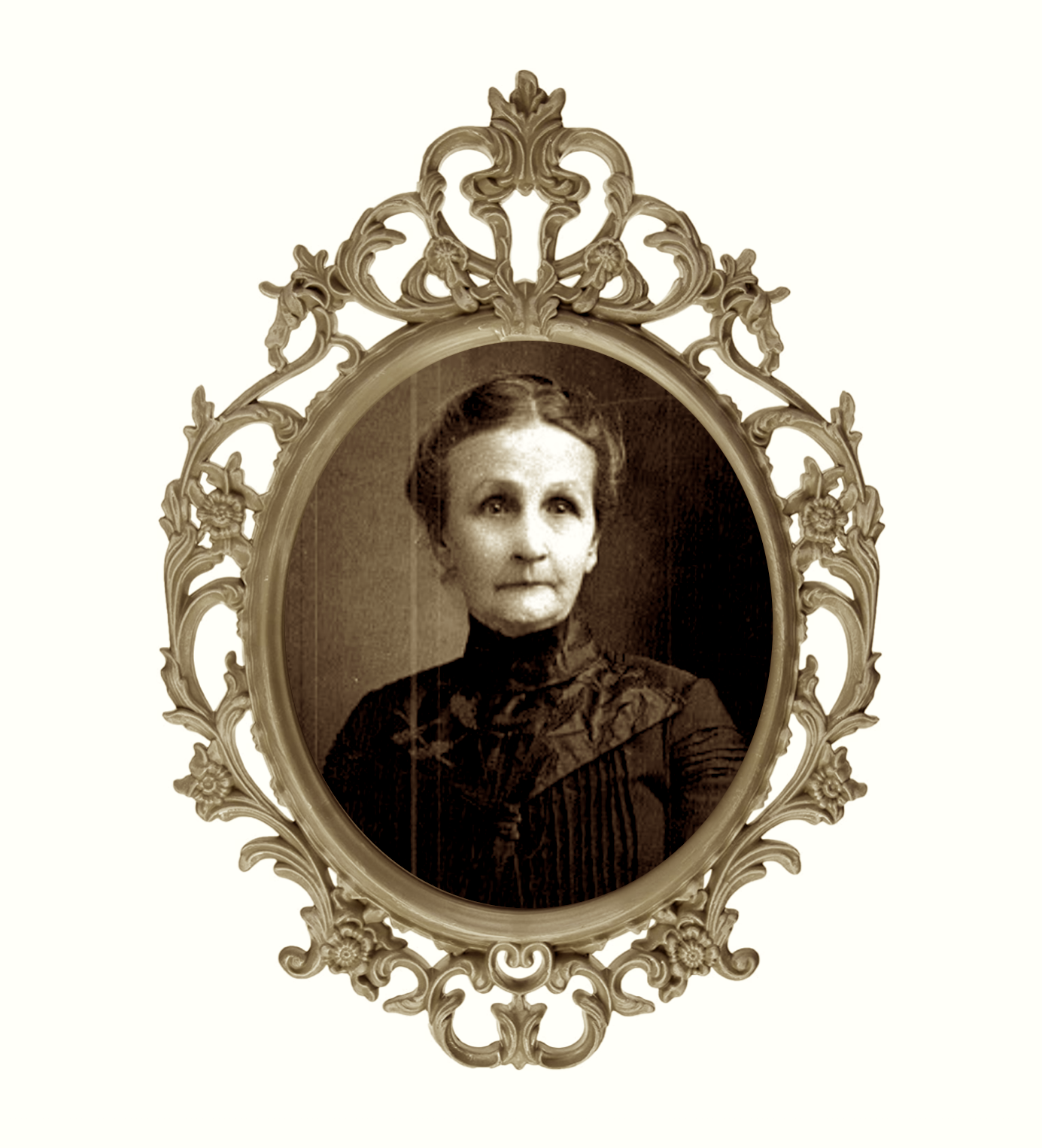

Surprisingly little has changed! 

It’s comforting to know you can still pair a steamed pork bun from Wing Lee with a latte from Blue Danube, grab a slice from Georgio’s, or lose yourself in the stacks at Green Apple books. 

And it’s reassuring that the battalion of dusty Ultraman action figures still stands sentry, presiding over the Toy Boat gelato counter, silently awaiting your next visit.
 

09/12/2022

  • 1 comment
  • Share
    TRAVELOGUE | DAYS 7 - 8

    Share link

in Pop Culture, Jazz, Motivation, Mindfulness, Oral History, Favorites, Dmitri Matheny Group, Memorabilia, Dmitri Matheny Memoir, Bidness, San Francisco, Intention, Literature, Superheroes, Simplicity, Roots, Japanese Culture, Resourcefulness, Change, Refreshing Beverages, Love, Home

TRAVELOGUE | DAYS 4 - 6 

Traveled 424 miles for jazz workshops at high schools and colleges in and around Sacramento, Silicon Valley, the Wine Country, and the East Bay. 

You never know what challenges or opportunities may arise on the road. I always try to have flexible plans that can adapt as circumstances change. I’m determined to enjoy every moment of this tour in spite of the historic heat wave. 

I love it here. I lived in the Bay Area for twenty years (1989-2009) so this trip feels like a homecoming.

Between gigs I’m reconnecting with old friends and my heart is full. 

Big thanks to Ann & Lalo, Mary & Peter, Julie, Tom, Ian, and Harvest Hosts for the hospitality!

09/09/2022

  • Leave a comment
  • Share
    TRAVELOGUE | DAYS 4 - 6

    Share link

in Jazz, Motivation, Mindfulness, Favorites, Dmitri Matheny Group, Dmitri Matheny Memoir, Bidness, San Francisco, Intention, Simplicity, Resourcefulness, Change, Refreshing Beverages, Love

TRAVELOGUE | DAY 3 

Traveled 296 miles today from Ashland to Sacramento. 

The drive down was relatively uneventful. Saw smoky skies and plenty of fire devastation in and around the town of Weed. 

My beloved Hi-Lo Cafe was closed (sigh, no pie) and the entire downtown area is still without power, but the hot shots seem to be making progress. The Siskiyou Wildfire is now 40% contained. 

Out of the fire, into the frying pan! Northern California is experiencing record high temperatures this week. So grateful to have air conditioning 24/7 in the mobile man cave. Thank you IcyBreeze! 

Tonight’s encampment: a Harvest Host in Arden-Arcade! #AlliterationNation 

09/06/2022

  • Leave a comment
  • Share
    TRAVELOGUE | DAY 3

    Share link

in Music Videos, Jazz, Motivation, Mindfulness, Role Models/Mentors, Dmitri Matheny Group, Bidness, San Francisco, Intention, Poetry/Song Lyrics, Resourcefulness, Change

TRAVELOGUE | DAY 1 


Packing up the tour bus for two weeks in Northern California!

It’s thrilling to return to road life, dodging fires, floods, and viruses to share our music with the people.

Seriously, some of these AP photos along I-5 look like something straight out of a Mad Max movie, so we’re mapping a couple of alternate routes south just in case. 

Today I'm grateful for the wise Minnie Pearl, who said it best:

“Take the back roads instead of the highways.” 


09/03/2022

  • Leave a comment
  • Share
    TRAVELOGUE | DAY 1

    Share link

in Pop Culture, Jazz, Quotes, Motivation, Mindfulness, Role Models/Mentors, Dmitri Matheny Group, Dmitri Matheny Memoir, Bidness, San Francisco, Intention, Film, Advocacy, Resourcefulness, The South

TRAVELOGUE DAYS 7 & 8 

Yesterday Scout and I woke to the sound of raindrops on the roof of our tour bus. She tilted her head and stared up at the ceiling in wonder. I immediately fell asleep again. Rain is a terrific soporific. 

Then the sun came out and announced the beginning of spring. It was a big day for my CaCo (aka Canine Companion, pronounced “Keiko”). We visited three parks: Magnolia Park in Oakley, Tex Spruiell Park in Livermore, and Joaquin Miller Park in Oakland. She charmed everyone we met, of course. 

In the evening I dropped her off for a puppy party with celebrity friend Berkeley (you.see.berkeley on Instagram), and then I headed over to the Sound Room to earn a little more kibble cash. 

I had a ball with pianist Ken French, bassist Ruth Davies, drummer Mark Lee, and special guests guitarist Ed Dunsavage and vocalist Cary Williams. The convivial crowd included many friends I haven’t seen in ages, including several well-known musicians.

The old Sound Room was already a favorite; this new, improved venue is even better. Thank you, Karen and Robert! We’re looking forward to returning in September for our album release celebration. 

Today Scout and I hit the road for Southern California.

So far, so good.

03/20/2022

  • Leave a comment
  • Share
    TRAVELOGUE DAYS 7 & 8

    Share link

in Jazz, Motivation, Mindfulness, Oral History, Listening, Dmitri Matheny Memoir, Bidness, San Francisco, Intention, Fame & Popularity, Rain, Resourcefulness, Scout

TRAVELOGUE DAYS 5 & 6 


Scout and I spent yesterday at The Klub in Glen Ellen, the exclusive wine country getaway expertly owned and managed by our dear friends Rocket, Peaches, Jasper, and Wilson. It was our first grand reunion since the beginning of the damndemic. So good.

Today I coached the San Mateo High School jazz band while Scout visited the groomer. The jazz kids were engaged, focused, and inspiring, a credit to Maestro Til, the head coach. The pup emerged from the beauty parlor looking (and smelling!) more fabulous than ever. 

Tonight it’s long tones in the mobile practice room (big show tomorrow), and if we aren’t too tired, a movie before bed, preferably one that isn’t too stressful, without dogs barking in the audio track of every establishing shot. 

Funny how ubiquitous those movie dogs have become. There’s one particularly distressing bark they use over and over, like the Wilhelm Scream. Let me tell you, Scout is not a fan! So we’ll do our level best to find something hopeful and barkless to send us off to dreamland.

03/18/2022

  • Leave a comment
  • Share
    TRAVELOGUE DAYS 5 & 6

    Share link

in Pop Culture, Jazz, Motivation, Mindfulness, Oral History, Listening, Youth, Esoterica, Dmitri Matheny Memoir, Bidness, San Francisco, Intention, Film, Dreams, Resourcefulness, Scout

TRAVELOGUE DAYS 3 & 4 

Scout and I have had a wonderful couple of days in the San Francisco Bay Area. 

We explored the Redwood Glen and Palos Colorados trails, had a puppy party at the Oakland Dog Park, visited with friends old and new, and spent two nights on a farm! This afternoon we’re headed to the wine country.

I also presented a couple of jazz workshops in area high schools, so this is a legit work trip, not a vacation (ahem).

#BoondockerBoondoggle

03/17/2022

  • Leave a comment
  • Share
    TRAVELOGUE DAYS 3 & 4

    Share link

in Jazz, Oral History, Dmitri Matheny Memoir, Bidness, San Francisco, Simplicity, Health & Fitness, Scout

TRAVELOGUE DAY 2 


Destination: Oakland CA 

Distance: 306 miles 

Lovely day yesterday traveling with my best girl through Washington and Oregon to California. 

We enjoyed the rain, listened to murder mystery audiobooks, and made excellent time on I-5, considering all the pit stops for puppy walks and pie!

Today (3/15) we ease on down the road to the San Francisco Bay Area.

03/15/2022

  • Leave a comment
  • Share
    TRAVELOGUE DAY 2

    Share link

in Motivation, Mindfulness, Oral History, Listening, Bidness, San Francisco, Simplicity, Rain, PNW Life

THE OWL CLUB PART 5 — PARLIAMENT 


“Beware the Court of Owls, that watches all the time,
Ruling from a shadow perch, behind granite and lime.” 
—Scott Snyder 


When Mr. Higgins told me how the Owl Club boasts many prominent artists and musicians among its members, I was skeptical.

I figured there are probably a small number of movie actors and rock stars sprinkled among their highfalutin order. I imagined that any artist members would have to be the type of mainstream celebrities that impress rich people and share their classist, politically conservative views. Even the pedigree of someone like Gordon Fleecing (British, famous) fit with my assumptions about this not-so-secret society. 

But learning that Sweets — one of my personal heroes! — was a member? This blew my mind.

Because Sweets is not some rich white guy, mind you, but an African-American gentleman of modest means. Not a business mogul but a retired school teacher. Not a celebrity so much as a master craftsman, highly respected among our peers in the community of musicians. Hard-working. Dignified. Sincere. Real. 

For all my trepidation about this club and groups in general, I must admit that his involvement intrigued me. 


It’s springtime in San Francisco, and another typical workday in my three-ring circus of a life. Morning at the festival office dealing with demanding sponsors. Afternoon at the record company dealing with complacent distributors. Evening on the bandstand dealing with this unforgiving horn. 

The plates never stop spinning and I always feel as if I’m neglecting something or someone somewhere. But tonight brings a welcome pause in the routine. After our show an audience member approaches the stage and offers to buy me a drink. 

His name is Gregory. He’s a guitarist. We barely know one another, yet he speaks to me with the warm familiarity of an old friend. He asks how I’ve been, inquires about my wife and family, and shares some intimate personal details of his own.

Delighted to have made a new friend, I sip my single malt as we sit together, chatting amiably until the lights come up and the club empties out. In the parking lot Gregory hands me a small envelope. 

“We're having a party in the city tomorrow,” he says. “You should come.”

As he drives away I open the envelope. Inside is a thick card embossed with raised lettering: Cocktails In The Cartoon Room.

I’ve never heard of the place, and there’s no address on the invitation, but in the lower righthand corner is the now familiar telltale symbol: the Owl of Athena. 

Well I’ll be damned. 


The Cartoon Room, it turns out, is no place for introverts like me.

I’ve been here before. This massive barroom, with its chaotic jumble of paintings and posters, was overwhelming on my first visit, but tonight the place is packed, shoulder-to-shoulder, with glad-handing, back-slapping, martini-swilling men, all laughing and shouting over the sounds of big band jazz. 

I scan the room for Gregory (no luck) then jostle my way through the crowd and up to the long redwood bar. Before I can utter a word the bartender casually greets me by name. 

“Mr. Matheny. So glad you could make it.” He pushes a tumbler of amber liquid across the counter. “Lagavulin, neat, yes?” A stranger who knows my name and my drink. What sorcery is this?


I'm about three fingers in when the far wall slides open to reveal a 25-piece swing orchestra in mid-shout chorus, capped off by a tasty trumpet solo from none other than Sweets Allen. The room erupts into boisterous applause. 

How wonderful! I assumed the music was piped-in, but it’s live, and excellent. I recognize several of the musicians. Are they all members, I wonder, or hired help?

I want to pay my respects to Sweets and the other musicians, but I’m unable to get to them through the throng. The place is a madhouse. The guy who invited me isn’t here. The whole situation feels peculiar, like I’m supposed to do something, but I don’t for the life of me know what it is. So I stay about an hour, making awkward small talk with strangers, until the claustrophobia kicks in and the crowd becomes too much to bear. 

As I cross the Bay Bridge home I ponder my perplexing experience in the parliament of owls. 

“I felt like Alice going through the looking-glass,” I confess to my wife over dinner.

“They were clearly expecting me but nobody said anything.” 

She raises an eyebrow. “Maybe it was some kind of test.” 

“If so,” I reply, “Then I most definitely failed.” 

03/06/2022

  • Leave a comment
  • Share
    THE OWL CLUB PART 5 — PARLIAMENT

    Share link

in Art, Pop Culture, Jazz, Quotes, Motivation, Mindfulness, Oral History, Role Models/Mentors, Listening, Mystery, Esoterica, Dmitri Matheny Memoir, Bidness, San Francisco, Literature, Poetry/Song Lyrics, Fame & Popularity, Owls & Weaving Spiders, Refreshing Beverages, Home

THE OWL CLUB PART 4 — SWEETS 


“I hide in plain sight. 
Same as you.” 

—Gustavo Fring 


I’m not a superstitious person by nature, but I was raised in the south where even educated folks recognize the power of signs and omens. Charlie’s gift of a tiny silver owl felt like such a signifier to me: a talisman of unknown provenance and portent. 

I began to carry the mysterious little figurine in my pocket, where it would gently jingle against my mouthpiece and pocket change as I walked. I carried it everywhere, like a good luck charm, and it seemed to be working. Within a few short years I’d established myself in San Francisco as a working musician, and had sold enough sponsorships to increase our jazz festival budget ten fold. 

In hindsight, this was during the tech boom of the early 1990s. Gigs were plentiful then because there were so many gainfully employed young people looking for a night out, and donations were up, too. The dot com bubble was expanding, the stock market was booming, and corporate support for the arts was ascendant. Bay Area businesses needed somewhere to park all that extra cash. Why not a nonprofit that offers exciting social events and a tax write off? It was an easy sell. 

I didn’t have that perspective at the time, however. Naively I thought I’d cracked the code! I felt powerful, like a double agent: professional jazz musician by night, hot shot sponsorship salesman by day. Oblivious to the unseen economic forces that conspired to pave my way, I credited my own skill and hustle, with perhaps just a little bit of secret “owl luck” thrown in for good measure. 

Over time my magical thinking grew deeper, abetted by echoes. Not only was I carrying the owl totem in my pocket, but I also began to notice similar statuettes in the executive offices of prospective sponsors. 

I would be in mid-pitch, sitting across from some corporate mucky-muck, when I would look over at the shelf behind them, and there it would be: another owl statue. I never said anything, but on more than one occasion I sensed a subtle nod or look of acknowledgment when I spied the owl. 

Like, I saw it. They saw me see it. Now what? 


It’s Tuesday night in San Francisco, and I don’t have a gig of my own, so I’m headed over to Sonny’s Place in North Beach to hear the incomparable flugelhornist Sweets Allen. 

For true fans of lyrical swing, it gets no better than Sweets and his honey-toned horn. He’s the real deal, a veteran soloist from the bands of Duke Ellington, Ella Fitzgerald, and Tony Bennett. Now in his 70s, Sweets is one of San Francisco’s most beloved musicians and one of the last great gentleman of jazz. 

For me, Tuesdays at Sonny’s are like graduate school. I rarely miss the chance to attend one of these weekly masterclasses.

Tonight Sweets is really living up to his name. His improvised lines are powerfully simple, pure, soulful, logical, and undeniably joyful. The warmth of his sound and the smile on his face combine to lift the spirits of everyone in the club. 


On the break I motion for him to join me at my table. Like my father, Sweets is a former school teacher, a wise elder who doesn’t mind sharing his accumulated knowledge. He patiently answers all my questions about music and life. 

“The main thing is to tell a story,” he advises, tapping his finger on the table for emphasis. “But it’s not like reciting a poem or singing a song. It’s got to be your story.” 

“Just be real,” he adds, “and never let the naysayers get you down. They’re everywhere, so keep your head on a swivel.” 

“Like an owl,” I say quietly. 

“Precisely,” he smiles, standing. 

“Which reminds me,” he adds before returning to the bandstand. 

“A little birdie told me you may be joining us.” 

Next:
THE OWL CLUB PART 5 — PARLIAMENT

02/27/2022

  • Leave a comment
  • Share
    THE OWL CLUB PART 4 — SWEETS

    Share link

in Art, Pop Culture, Jazz, Quotes, Encouragement, Motivation, Mindfulness, Oral History, Role Models/Mentors, Favorites, Listening, Mystery, Dmitri Matheny Memoir, Bidness, San Francisco, Intention, Poetry/Song Lyrics, Simplicity, Restraint, Resourcefulness, Art Farmer, Owls & Weaving Spiders

THE OWL CLUB PART 3 — THE GIFT 

“Open your minds, my friends.
We all fear what we do not understand.”

—Robert Langdon 


Charlie Higgins leads me by the arm into a space entirely unlike the rest of this mysterious fortress. 

The dining room is sunny, warm, and elbow-to-elbow with convivial groups of men in business attire, eating, drinking, talking and laughing.


“This is us,” Charlie says as we approach a corner table where a couple of seated gentlemen rise to greet us. “Let me introduce you to two of the original hep cats, Walt Connor and Will Cooley. Gentlemen, this is Dmitri Matheny.” We all shake hands and sit down together. 

At each place setting a single card embossed with the now familiar OC logo offers a simple selection of steak, seafood, sandwiches, and salads. I’m delighted. Since moving to San Francisco from Boston a few years ago I’ve enjoyed a steady diet of international and vegetarian fare. I’ve even learned to appreciate California cuisine with its requisite avocado, pine nuts and sun-dried tomatoes. But I was raised on American comfort food from cafeterias and diners. This is my kind of menu. 

Nevertheless, I decide to order something I’ve never tried before, a Crab Louie Salad. Based on the name, I’m fairly certain that I will enjoy at least two thirds of it.


Over lunch, Charlie cheerfully embodies his role as table host, guiding the conversation so as to include everyone. In spite of our difference in age (I’m in my late 20s and they’re all in their 60s) we all get along swimmingly. 

Curiously, no one discusses business. Charlie, the candy magnate, talks about his experience as a paratrooper in World War II. Will, a Southern California real estate developer, holds forth about Stan Getz and his involvement in the committee for jazz at Stanford University. Walt, an author and photographer (who may or may not also be heir to a large national department store fortune) speaks with authority about the forgotten history of jazz on the Barbary Coast. I mostly listen, fascinated by these wise old owls. 

As coffee is served, Charlie casually turns the conversation to the unique history and ethos of the Owl Club. Unlike other quote-unquote secret societies and fraternal organizations, Charlie explains, we aren't centered around a particular industry, sport, or school, but a common interest in nature and the arts. 

“Our membership roster includes not only prominent businessmen and CEOs,” Charlie says proudly, “but writers, journalists, military heroes, politicians, global leaders, and many well-known artists and musicians.” 

I'm intrigued. “But no women?”

Charlie smiles. “You know, a hundred twenty years ago when this club was founded, men tended to stay in their unhappy marriages. They needed clubs like this as an escape. Of course these days, if you aren’t happily married, you get a divorce. That’s why so many of our happily married members are now requesting more events to which they can bring their spouses.” 

Taking this as my cue, I pull the glossy jazz festival sponsorship brochure from my breast pocket and lay it on the table. I’m just about to begin my pitch when Charlie interrupts me, raising his hand and saying, “no-no-no, not here.” A red-vested waiter immediately approaches to ask that I “kindly put away the literature.” 

“I’m sorry, I thought …” I stammer, befuddled. 

“We can discuss all that later,” Charlie replies magnanimously. 

At precisely this moment, as if responding to a silent alarm, everyone stands to say their goodbyes. I stand too, shaking hands with Will and Walt, who leave together.

Charlie places his arm around my shoulder and ushers me back through the grand foyer, past the empty bar with its mad jumble of framed art, to the dark alcove where I first entered the building. It looks somehow different to me now. Less off-putting. More cozy.

“What a pleasure,” I say. “Thanks for lunch.” 

“Ah! I almost forgot!” Charlie replies, reaching into his pocket. He retrieves a small box, about 4 inches in diameter, wrapped in white paper. “This is for you.” 

On my way back to the jazz office, I stop by the piano bar at Kuleto’s, my favorite Union Square watering hole. I find a seat by the fireplace and order a bourbon, neat, feeling not unlike a noir detective at the beginning of a perplexing new case. 

I unwrap the mysterious gift box, genuinely curious what I will find inside. 

Perhaps some chocolate truffles from Charlie's candy company? But no.

I place the heavy totem onto the table in front of me and study it.

No card, no explanation.

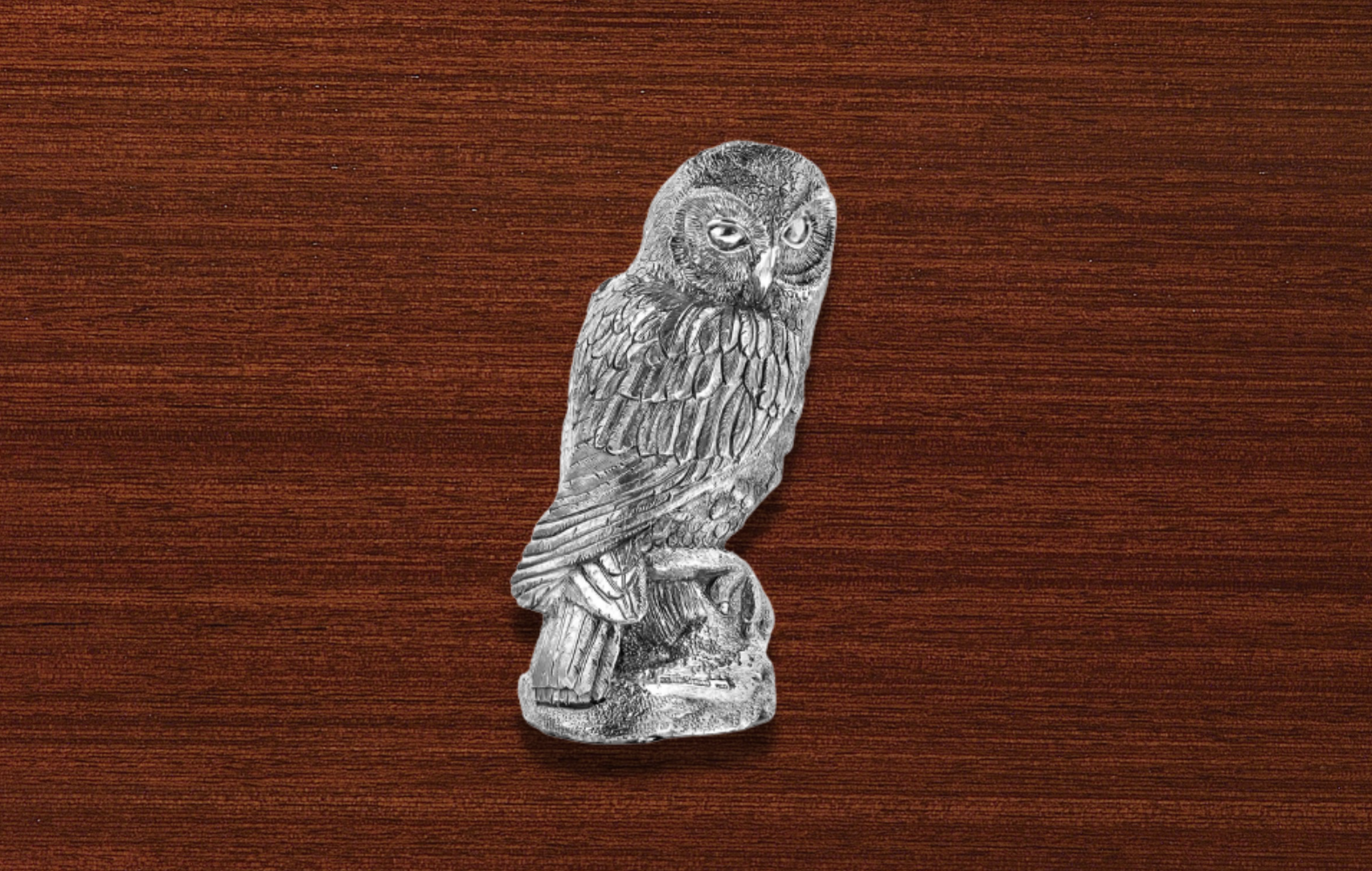
Just a tiny silver owl. 

Next:
THE OWL CLUB PART 4 — SWEETS

02/20/2022

  • Leave a comment
  • Share
    THE OWL CLUB PART 3 — THE GIFT

    Share link

in Art, Pop Culture, Jazz, Quotes, Motivation, Mindfulness, Oral History, Favorites, Listening, Mystery, Esoterica, Memorabilia, Dmitri Matheny Memoir, Bidness, San Francisco, Film, Simplicity, Humility, Owls & Weaving Spiders, Refreshing Beverages, Love

THE OWL CLUB PART 2 — A WEAVING SPIDER  


“Weaving spiders, come not here; 
Hence, you long-legg'd spinners, hence! 
Beetles black, approach not near; 
Worm nor snail, do no offence.” 

—William Shakespeare 


The Owl Club’s downtown headquarters, a stately ivy-covered red brick building off Union Square, turns out to be just a short walk from our jazz festival offices south of Market. 

I’m curious, of course, why Charlie Higgins invited me here, but truth be told I have my own agenda. Based on the Fleecing concert, many of our city’s business leaders and arts patrons are apparently members of this club. In fundraising parlance, this place could be what’s known as a “happy hunting ground.” 

I stand before the club entrance and study the large bronze plaque beside the door. It’s a Great Horned Owl in bas relief, its wings outstretched. In welcome or warning? I wonder. 


I open the heavy wooden door and enter the dark chamber. It's drafty and deserted, with no signs of life other than the warm glow of a single unattended fireplace along one wall. Am I early? Guess I’ll have a look around. 

From the grand foyer with its high vaulted ceilings, I take in the antique lighting fixtures, wood paneled walls, tall shelves of leather bound books, and low mahogany tables surrounded by clusters of empty armchairs. Down a quiet hallway I find sitting rooms and salons, meeting rooms, galleries, a music library, even a small theater, but no dining room and no people. Not a living soul. 

Across the hall is a beautiful redwood cocktail bar, also unoccupied, yet entirely overpopulated with visual art in what can only be described as a surreal assault on the senses. The walls of this room are literally covered, floor to ceiling, with a chaotic jumble of ancient oils, sylvan landscapes, faded portraits, sepia photographs, and dozens of hand-painted event posters, all of them adorned with whimsical cartoons and carnival words. Carefree! Frolic! Hi-jinks! It’s dizzying. 

I pick up a bar napkin to wipe my brow and notice the logo: it’s the Owl of Athena in profile flanked by the initials O and C. This is definitely the place, so where the hell is everybody? I feel like that guy in The Twilight Zone, only instead of wandering solo through Mayberry I’ve somehow stumbled into a haunted saloon or abandoned hotel. 

But am I really alone? Because I feel like I’m being watched. 

That’s when it hits me. I realize with a shudder that all around me, looking at me from every corner, are the eyes of owls. Owls staring from every shelf, peering out from the paintings and posters, glaring down from a stained glass window. Owl faces printed on the wallpaper, carved into the wainscoting, even woven into the very carpet beneath my feet. 

Most unsettling of all is the large bronze owl shape directly in front of me. It has no face at all, just a blunt featureless void, giving the impression of both a very modern abstract sculpture and an ancient idol of the pagan underworld.
 

“Beautiful creatures,” intones the familiar voice of my host, suddenly standing right next to me. 

“Fierce hunters, too,” he goes on. “They can swallow their prey whole, bones and all. I’ve seen it!” 

“You sound hungry, Chuck” I say. 

“Let’s eat,” he replies.

Next:
THE OWL CLUB PART 3 — THE GIFT

02/14/2022

  • Leave a comment
  • Share
    THE OWL CLUB PART 2 — A WEAVING SPIDER 

    Share link

in Art, Pop Culture, Jazz, Quotes, Motivation, Oral History, Dmitri Matheny Quotes, Mystery, Esoterica, Dmitri Matheny Memoir, Bidness, San Francisco, Intention, Literature, Poetry/Song Lyrics, Owls & Weaving Spiders, Argot

THE OWL CLUB PART 1 — INVITATION  


“Men have a desire for stability, security, repetition and order in their lives. 
At the same time they have a tendency to want to flee, 
to meet the adventure, and to destroy.” 

—Stanley Kubrick 


I’ve never been much of a joiner. 

Never had much use for clubs or cults or crowds. 

Large gatherings and groupthink make me uncomfortable. 

It’s one of the reasons I prefer playing an intimate jazz venue over a huge music festival. It’s why, even though I’m a serious Green Lantern collector, I can’t bring myself to attend Comic-Con. It’s why I never cared much for church or theme parks or spectator sports. It’s even why, at the apex of my Buddhism studies, I had to leave the San Francisco Zen Center. I could handle the silent sitting, but as soon as the chanting began, I got the willies and hightailed it the hell out of there. 

But of all the creepy crowds I’ve ever encountered, none compare to The Owl Club. 

Our story begins in the early ’90s, at San Francisco’s elegant Herbst Theater, where the brilliant blind pianist Gordon Fleecing is playing to a full house. Fleecing and his trio are in fine form, enchanting the sophisticated audience with their witty and clever takes on the Great American Songbook. 

I’m standing in the wings wearing my only suit, feeling like a fraud as my boss and I peer through the curtains at the well-heeled crowd. I’m only half listening to the music, because I’m there in a professional capacity, not as a jazz musician, but as a fledgling fundraiser. I’ve recently begun writing grants and selling sponsorships for the concert’s producer, the mercurial jazz impresario Kendall Lane. 

“Isn’t this great?” Kendall asks, squinting and smirking in triumph. His smile, if you can call it that, seems weirdly disingenuous, but the man has good reason to feel proud. The concert is a sold-out success and many of the city’s movers and shakers are in attendance. Tonight is a big night for our scrappy little organization. 

At that moment something curious catches my attention. While improvising over the unmistakable chord changes to Autumn Leaves, Fleecing begins to play a different theme, something whimsically wistful, redolent of a European folk song.

This melody is unfamiliar to me, but a smattering of applause around the recital hall suggests that a dozen or more of our patrons have immediately recognized the song’s provenance. From our position at the side of the stage, we can see several captains of industry making eye contact with one another and nodding their heads in approval as Fleecing transforms the simple melody into a grandly majestic anthem. 

In the lobby at intermission, I walk over to greet Charlie Higgins, the sponsor of tonight’s show. 

I dig Charlie. He carries himself like one of the “good old boys” back home. He’s the real deal, a true believer and a genuine music lover with a jovial nature and a ready handshake. You wouldn’t know it to look at him, but Charlie is a great philanthropist, too. He and his candy company have underwritten nearly every significant jazz event on the west coast for years. 

“Isn’t this great?” I repeat Kendall's line.

“Yes, indeed!” Charlie smiles broadly. 

“Hey, what was that song Fleecing quoted?” I ask. “You seemed to recognize it.” 

“The Soul of Bavaria,” Charlie replies. “It’s a favorite at the club. Fleecing is a longtime member.” 

“Ah, the club. Of course.” I nod solemnly, understanding nothing. 

“Why don’t you join me there for lunch next week,” Charlie asks casually, as if the idea had just occurred to him. 

“It would be my pleasure,” I accept. I'm mystified but intrigued by the surprise invitation. 

That night over dinner I consult my wife. She seems to have an innate understanding of such things. 

“I've been invited to lunch next week with Charlie Higgins. I'm not sure why. I think it’s at a private club. Do you know of a club in the city where an American executive and a British jazz pianist would both be members?” 

Her eyes widened. “You mean The Owl Club?

We’d better get you a new suit.” 


Next:
THE OWL CLUB PART 2 — A WEAVING SPIDER

02/05/2022

  • Leave a comment
  • Share
    THE OWL CLUB PART 1 — INVITATION

    Share link

in Jazz, Quotes, Mindfulness, Oral History, Listening, Mystery, Esoterica, Dmitri Matheny Memoir, Bidness, San Francisco, Film, Owls & Weaving Spiders

THE SECRET 


When I first met my hero Art Farmer, he was spending half his year at home in Vienna and the other half on tour.

Occasionally concert promoters would pony up for his New York band, but most of the time Art worked with local rhythm sections. Regardless, he hired the best musicians everywhere, and his ensembles never failed to impress.

"How do your groups always sound so good?" I asked him after a knockout performance at Kimball's in San Francisco. "What's the secret?"

"Dmitri, it's simple," he said. "If you find that you're the smartest cat in the room, you're in the wrong room."

10/11/2021

  • Leave a comment
  • Share
    THE SECRET

    Share link

in Jazz, Quotes, Encouragement, Motivation, Mindfulness, Oral History, Role Models/Mentors, Favorites, Listening, ShuHaRi, Dmitri Matheny Memoir, Bidness, San Francisco, Intention, Advocacy, Simplicity, Humility, Resourcefulness, Art Farmer

MEETING LELA | PART 7 — BISCUITS & GRAVY 


“We all grow up with inherited genes 
and inherited sensibilities, and 
they run very, very deep.” 

—John Lithgow 


To recap: it turns out that my estranged mother, who left us when I was a baby, was a singer. Although she never recorded, Lela had an active performing career singing torch songs in Tennessee nightclubs with her combo. And apparently my father was a fan who regularly attended her gigs before they met and married.

So music, my passion in life, is what originally brought my parents together, yet neither of them thought to tell me. I chased my dream obliviously ignorant of this history. I chose this path all on my own, or so I thought until age 46, when Lela showed up to one of my gigs and dropped a DNA bomb on my self-made origin story. 

I wonder what Mr. Stockdale would think of all this. I didn't fully appreciated those MACOS nature/nurture lectures at Brookstone until this moment.

After Lela returned home to Michigan we took up where we had left off as penpals. She shared more wild yarns about America McGee (whose very existence I doubted), but the primary focus of our correspondence had now shifted to our shared interest in music.

“When you were singing, who were your influences?” I asked. “Any favorite artists or albums?” 

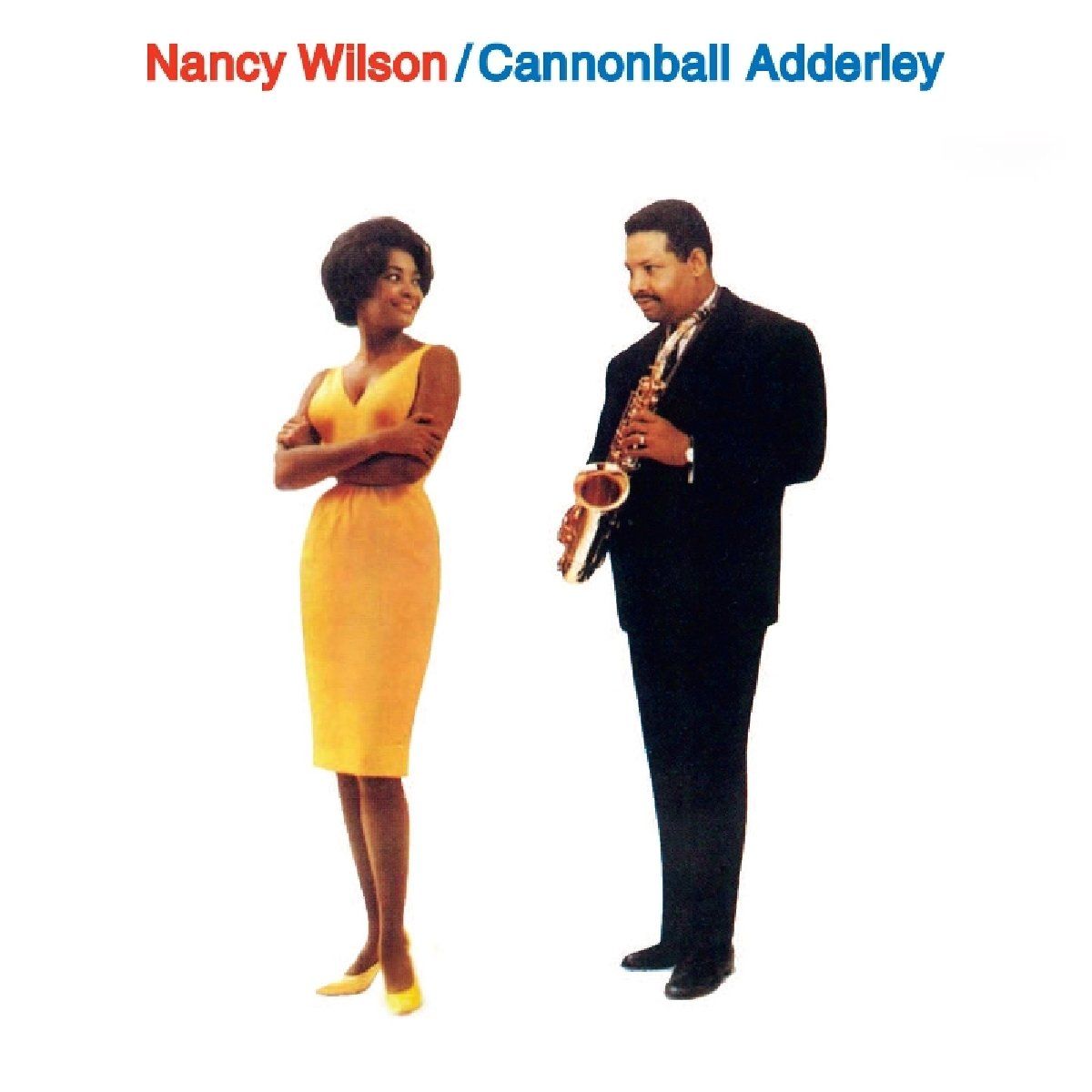
“Well, if you ever get a chance to hear a record that Nancy Wilson made with Cannonball Adderley, that one is very special to me,” she replied. “I played that album to death when it came out and learned all of it by heart. I was probably singing those songs while you were in the womb!” 


This revelation struck me like a thunderbolt. To find out that a classic jazz recording I’ve admired and enjoyed all my life also happened to be formative and personally significant for my mother? Damn. I wondered how much more we might have in common. 

Lela must have been curious about this as well, because a few days later a Zune portable media player arrived in the mail with this note: 

Here’s my music collection. 
This will tell you more about me 
than words can ever say.


She was right. Her cherished music encompassed many genres, from classical to country to jazz and blues, and I loved all of it. Our likes were so eerily similar, in fact, that it would feel self-congratulatory to compliment her excellent taste.

The overlap in our music libraries was uncanny. Of the several thousand songs and artists in Lela’s playlist, nearly all were already prized plums in my own collection. She sent Sarah Vaughan with Michel Legrand, Elly Ameling singing Schubert, Ahmad Jamal Live At The Pershing, Chet Baker on Pacific Jazz, all the Ella Fitzgerald songbooks, John Coltrane and Johnny Hartman, Patsy Cline Showcase, Anita O’Day Travelin’ Light, nearly everything Miles Davis did in the 1950s and ’60s, some recent recordings by Diana Krall and Shirley Horn, and soooo much Nancy Wilson, clearly her favorite. Lela even included Willie Nelson’s cover of “Stardust!” Amazing. 

Only a handful of the artists in her list were new to me (Jo Stafford, Helen Forrest, June Christie) and their songs resonated so deeply that they immediately became part of the soundtrack of my life. Driving around the Lonesome Desert at night, listening to my mother’s favorite music, made me feel a profound sense of connection to her in spite of the fact that we were basically strangers to one another.


I met Lela only once more. 

In April 2014, while on tour in Michigan, Sassy and I accepted an invitation to visit her at home in rural Potterville.

Lela and Bill Horton (of Mr. Bill’s Adventureland), her husband of 23 years, received us warmly. Lela even cooked biscuits and gravy for us! Sitting there at my mother’s kitchen table, watching her fix me breakfast for the first and only time in my life, flooded me with conflicting emotions. Gratitude. Wonder. Comfort. Melancholy. Loss. 

After our meal Bill gave us a tour of the rambling, ramshackle Horton house. The place was a packrat’s dream, filled to the rafters with papers, boxes, books, knickknacks, old computers, oxygen tanks, medical supplies and more. As Bill led us from room to room, Lela toddled behind, randomly tidying up and apologizing. “We don’t get many visitors.” 


I remember thinking how beautiful it was, that this frail and fragile couple were lovingly taking care of one another in their declining years. Will Sassy and I do the same? 

Bill was especially eager to show me their collection of records, tapes and compact discs. Lela had already sent me MP3s of most of it except for one major omission: the Hortons had amassed an impressive, damn near comprehensive stockpile of Dmitri Matheny CDs!

I was astonished. Not only did they own all my albums as a leader, they'd also somehow acquired a bunch of sideman recordings from my early years in San Francisco. Seeing this stash of obscure, out-of-print discs, I realized that Lela and Bill must have been quietly following my career for years, buying each new recording at the time of its release, long before I found Lela online. 

Flattering, yes, but also infuriating. I’ve had a website since 1995. Lela obviously knew where I was and what I was doing. Why had she never contacted me? I’ll likely never know.

In August 2018 I received a phone call from Bill Horton letting me know that my mother had died. He didn’t mention her cause of death, but I assume it was severe emphysema after a lifetime of smoking. 

“I also wanted to tell you that some years ago Lela and her brother inherited a parcel of land on a mountain near Chattanooga,” Bill said. “They sold it and she put her half of the money into a Vanguard account. You’re listed as beneficiary after I die. I’ll send you the paperwork.”

I remembered Lela's cryptic “mountaintop inheritance” call back in the 1980s. How about that? Another mystery solved.

I'm grateful that Lela and Bill Horton had so many good years together, and glad I had the chance to visit them before she died. Bill and I have stayed in touch since Lela’s passing and I’m glad. I’ve come to think of him as part of the extended family, especially now that both my mother and father are gone from this world.

The other day Bill sent me an antique sepia photograph. 

“Lela would want you to have this,” he said. 

“It’s a picture of your great-great-grandmother ... Matilda America McGee.”

MEETING LELA
Part 1 — The Frosty Frog
Part 2 — Chattanooga
Part 3 — Adventureland
Part 4 — America McGee
Part 5 — Under The Stars
Part 6 — Gifts
Part 7 — Biscuits & Gravy

09/13/2021

  • Leave a comment
  • Share
    MEETING LELA | PART 7 — BISCUITS & GRAVY

    Share link

in Jazz, The Desert, Quotes, Motivation, Mindfulness, Oral History, Dmitri Matheny Quotes, Favorites, Listening, Mystery, Youth, Memorabilia, Dmitri Matheny Memoir, Bidness, San Francisco, Intention, Film, Interlochen, Roots, Change, Bill Matheny, The South, Love, Home, Sassypants Poutypuss

MEETING LELA | PART 5 — UNDER THE STARS 

“The only thing new in the world
is the history you do not know.”
 
—Harry S. Truman


Since Lela’s last Irish goodbye, I’d grown up, moved out, finished high school in Michigan, graduated from college in Massachusetts, lived in California for twenty years, and traveled all over the world. I’d made my bones, married, divorced, and moved on. Suffice to say, it had been awhile. 

Then in 2009 I returned to the Lonesome Desert with my girlfriend Sassy. Daddy Bill’s health had taken a turn for the worse, so I bought us a house in a bedroom community outside of Phoenix and fixed up a room for him. He would often come to visit but always left after a day or two, stubbornly refusing to move in. “I don’t want to be a burden,” Daddy Bill said. “Besides, I prefer my little Hermit House by the Pinaleños.” 


In October 2012 the Dmitri Matheny Group played Music Under The Stars in Tucson. The open air concert felt like a homecoming. Presented by the very jazz society that gave me my first scholarship when I was fifteen, the event was held at Tohono Chul Park, my not-so-secret hideout during the CDO years. I’d spent many soul-restoring hours in the desert gardens of Tohono Chul back in the day, and I had returned to the Old Pueblo many times over the years for concerts. But this event was special. Both my father and biological mother were in the audience. 


The show was a grand success. The crowd was warmly receptive and our performance could not have gone better. I was so proud of my band, especially Akira Tana, who’d flown in from California for the occasion. But the great highlight, for me, was re-introducing Dad and Lela to one another after the show. 

“Well, I’ll be damned,” Daddy Bill said upon seeing Lela. “I thought you were dead.” 

“I thought you were dead,” Lela replied. 

Delightful.

I left them alone to chat a bit while I packed up my gear and settled up with the band. Eventually the old man hit the road back to Hermit House, and I returned home with Sass and our surprise overnight guest. 

Back at the Maricopa Cabana, Lela and I sat side-by-side on the living room sofa. Tee many martunis later, story time was in full effect. For all her past reticence, my mother was now a free-flowing fountain of information, and for once, not just about America McGee. In vino veritas! 


To summarize, Lela never wanted children but she loved my father and “decided to give him a son.” It was an especially difficult and prolonged pregnancy. Lela was in labor for days. The delivery, when it finally came on Christmas Day 1965, nearly destroyed us both. I was a breach birth. The doctor had to extract me with forceps. My father cried when he saw my misshapen skull. Everyone feared I might not survive. Eventually my head retained its natural shape, however, and I turned out to be perfectly healthy. 


“You were my miracle baby,” Lela smiled, shaking her head, “but you nearly killed me. I never blamed you, of course. But I had to get the hell out of there.” It was the closest thing to an explanation I’d ever heard. 

We continued to talk and imbibe into the wee hours until both of us were slurring our speech. When we finally called it a night, Lela was a little wobbly on her feet, so I gathered her bony frame in my arms and carried her down the hall to the guest bedroom. I could scarcely believe that this little old woman, this tiny weightless bird, had ever given birth to anyone. 

“Oh, about your concert,” she mumbled as I turned out the light.

“You and I do a lot of the same repertoire.”

MEETING LELA
Part 1 — The Frosty Frog
Part 2 — Chattanooga
Part 3 — Adventureland
Part 4 — America McGee
Part 5 — Under The Stars
Part 6 — Gifts
Part 7 — Biscuits & Gravy

08/28/2021

  • Leave a comment
  • Share
    MEETING LELA | PART 5 — UNDER THE STARS

    Share link

in Jazz, The Desert, Quotes, Motivation, Mindfulness, Oral History, Dmitri Matheny Quotes, Favorites, Listening, Mystery, Youth, Dmitri Matheny Memoir, San Francisco, Intention, Literature, Interlochen, Roots, Change, Bill Matheny, Refreshing Beverages, Love, Home, Sassypants Poutypuss

MEETING LELA | PART 3 — ADVENTURELAND 

“Truth is not only 
stranger than fiction, 
it is more interesting.” 

—William Randolph Hearst 


After the Tennessee trip I called my father.

“Did you know that Lela was serious about music when she was in high school? She performed in musical theater, was a soloist in the choir, and sang standards in talent shows around Chattanooga. You never thought to mention any of this to your son, the professional musician?” 

Daddy Bill shrugged.

As fate would have it, Larissa and I divorced before ever having children, and I eventually lost interest in the mental and medical histories of my extended family. If crazy is in my genes, so be it.

But I remained curious about the length and depth of Lela’s relationship with music. When and how did she get her start? Did she continue to sing after high school? Is music still important to her? And does she know my work?

...now here's where the story really gets weird...

It’s 2008 on a rainy winter evening in San Francisco and I have insomnia. My South of Market loft is dark except for the glow of a single lamp and the faint flicker of a black and white movie on the tube. It’s Bogie and Bacall in a film I’ve seen many times. The volume is off but the images keep me company as I sip my scotch and surf the web. 

As usual during these liminal moments between work and sleep, I start out with benign intentions (checking the weather forecast, perhaps, or looking up a recipe) but eventually my online meanderings devolve into mindless consumption of celebrity gossip. 

I’m half in the bag when I notice that Marlowe is just about to enter the casino where Vivian Rutledge is singing. This is one of my favorite scenes, second only to Dorothy Malone in the bookshop, so I turn up the volume and listen. 


And her tears flowed like wine, 
Yes her tears flowed like wine. 
She’s a real sad tomato, 
She’s a busted valentine. 


I dig Bacall’s relaxed, cool delivery and the meaningful looks she exchanges with Bogie. Something in her casual manner reminds me of Lela sitting atop that piano singing “The Man That Got Away.”

It’s been a while since I last searched for Lela online so I decide to give it another go. I plug every iteration of her name into the ancestry sites and search engines: Lela Ault (maiden name), Lela Matheny (married name), even Lela Conte (the name of her late husband), but no luck. I don’t know her precise age, social security number, where she lives, which last name she now uses, or even if she is still alive. My cyber-sleuthing has once again hit a dead end. 

I’m about to give up entirely when I remember America McGee, the outlandish (and most likely imaginary) ancestor character from Lela’s shaggy dog stories back in ’79. On a lark I type that name into the search bar.

No joy, however, Google takes me to the Wikipedia page for American McGee, a video game designer. From there I bounce through various tech and gaming sites until I randomly arrive at Mr. Bill’s Adventureland, a multiplayer adventure game review site. By this point I've stopped looking for Lela; now I’m just aimlessly web surfing.

I’ve never been very interested in games of any kind, but for some reason I feel compelled to continue down this particular rabbit hole. I linger on the site for about an hour, reading all Mr. Bill’s reviews ... clicking, reading, then clicking again ... until I happen to land on the curious phrase “my wife Lela” — and I freeze. 

I know that there are thousands of women named Lela all over the world. I’m well aware of this. But somehow, at this moment, I can just feel it in my bones: this is she.This one is my mother. 

Without hesitating I click the contact button and write the following message: “Hi Mr. Bill, great website! I believe your wife Lela and I may know one another. Please give her my greetings. Sincerely, Dmitri Matheny.”

I hit send and immediately fall into a deep and dreamless sleep.

When I awaken a few hours later, I see this response from Mrs. Lela Horton in rural Michigan:

Dmitri, I can't believe it!
How on earth did you find me!!?

MEETING LELA
Part 1 — The Frosty Frog
Part 2 — Chattanooga
Part 3 — Adventureland
Part 4 — America McGee
Part 5 — Under The Stars
Part 6 — Gifts
Part 7 — Biscuits & Gravy

08/10/2021

  • Leave a comment
  • Share
    MEETING LELA | PART 3 — ADVENTURELAND

    Share link

in Music Videos, Pop Culture, Jazz, Quotes, Motivation, Mindfulness, Dmitri Matheny Quotes, Favorites, Listening, Mystery, Youth, Dmitri Matheny Memoir, San Francisco, Intention, Film, Poetry/Song Lyrics, Roots, Rain, Resourcefulness, Bill Matheny, Refreshing Beverages, Love, Recipes, Health & Fitness, Home

MEETING LELA | PART 2 — CHATTANOOGA 

“It’s good to know where you come from. 
It makes you what you are today. 
It’s DNA. It’s in your blood.” 

—Alexander McQueen 


In 1984 I was at boarding school in Michigan when my father called from Arizona to tell me about a long-distance phone call he had received from my mother. 

Her husband Tom had died after a prolonged bout with cancer. Now a widow in her forties, Lela was back in college studying to become a registered nurse. The reason (or pretense?) for her call was to ask for my social security number. Apparently she was updating her will and wanted to list me as beneficiary. 

“But you know how Lela is,” Dad said. “According to her you stand to inherit a mountain top of all things! I promised I’d let you know … even though it’s probably horseshit.” 

“Wait, where is she?” I asked my dad. 

“Did you get an address? What’s her phone number?” 

I already knew what he would say.

“Naw, I didn’t ask. Why do you care? She’s crazy!” 

Same old stubborn Daddy Bill.

I didn’t press him. Ever since Lela’s Irish goodbye in '79, I’d grown increasingly ambivalent about her. I had many questions, but it was clear to me that they would never be answered by her or by my father. 

A few years later just before my college graduation, Dad came to visit me in Boston. He’d recently divorced wife number four and he wanted to take me on a road trip.

We spent two weeks exploring New England, including one of his favorite birding spots, Mt. Desert Island off the coast of Maine. I would sit on the rocks for hours, playing my horn over the Atlantic, while Dad studied the flora and fauna of Acadia National Park. 

Dmitri Matheny - Mt. Desert Island, Maine | Summer 1988


In the evenings we’d enjoy delicious seafood dinners in Bar Harbor before retiring to our hotel, where we’d crack open a Sam Adams and reminisce. Perhaps because I’d been away for several years at Interlochen and Berklee, Dad was uncharacteristically talkative, so I took the opportunity to steer our conversation to wife number two, hoping to learn a little more about their brief time together and my own origin story. 

I noticed that if I asked Dad a direct question (“How did you and Lela meet?”) he would abruptly change the subject, but if I introduced the topic in a more oblique way (“Where did you live before I was born?”) he would begin to wax nostalgic and eventually would find his own way to Lela-land. 

I’ve forgotten much of what Dad told me during these late night chin wags, but I do recall him saying that Lela was raised in Chattanooga, not by her parents but by “two old maid aunts in a big house with white columns.” Apparently Lela and several members of her family (the Aults) had experienced “nervous breakdowns” and were “taken to the nut house.” Dad also mentioned a schizophrenic and homeless uncle who was known to wander the streets naked. “Every year they’d find him, clean him up, get him dressed, and bring him to Thanksgiving Dinner,” Dad said, shaking his head, adding “that whole family was crazy.” 

I didn’t give these accounts much credence, chalking them up to a combination of heartbreak, hearsay, and hyperbole, but a few years later, when I repeated these stories to my fiancée in California, she expressed concern. “It’s important for us to know the medical history on both sides of your family,” Larissa explained, “especially since we want kids of our own.”

I agreed, so Lara and I traveled to Tennessee on a Lela fact-finding mission. We didn’t learn much about the family but we did find out a few revelatory things about my mother's adolescence.

In the microfiche archives of the Chattanooga Public Library we found the obituary for Lela’s paternal grandmother and namesake, Lela Elizabeth Ault (born Bryson) 1878-1953.


Lela Bryson Ault
July 26, 1878
Dec 12, 1953


Since the article included an address for the Ault family home, we drove over to take a look and, sure enough, it was a big house with white columns, looking like something straight out of Gone With The Wind. We knocked on the door but no-one answered. 

Returning to the library we discovered my mother’s Chattanooga High School yearbooks. What a find! In official school portraits between 1957 and 1960, we see Lela Ault transform from a cute, mischievous girl into a mature, sophisticated young woman right before our eyes. 

Lela Ault - Chattanooga High School, Tennessee
(L-R) 1957-58, 1958-59, 1959-60


Her senior photo, in particular, is striking. There’s something deadly serious and almost defiant in her expression. At eighteen she already appears to be someone of substance, and the arts-centric bio blurb beneath the image supports this impression.

It turns out that Lela Ault was not only a visual artist in high school, but a prolific singer and performer as well. Who knew?! She sang in the choir and cantata, was a featured soloist in several student talent shows, and appeared in musical theater productions of Porgy & Bess, The Pajama Game and A Star Is Born. Moreover, as a member of the art service and specialty clubs, she was invited to perform off campus for various civic organizations around town. 

Prior to this moment I had no idea that Lela was a music person. In media interviews, whenever I was asked if I came from a musical family, I always answered “not especially” and credited my father’s excellent record collection as the catalyst for my career in jazz. I was raised to believe that nurture, not nature, had set me on this path.

But here, in the pages of a midcentury high school yearbook, was new evidence that I could not ignore: photos of my biological mother on stage, five years before my birth, singing jazz standards by George Gershwin and Harold Arlen. 

Lela Ault - Chattanooga High School, Tennessee | 1959-60
Singing "Summertime" and "The Man That Got Away"


A few days later we visited Daddy Bill's side of the family in Cookeville, Tullahoma, and Nashville.

“Did you know that Lela was a singer?” I asked my Aunt Maxine. 

“Oh, she had a lovely voice,” she replied. “We all thought so.” 

MEETING LELA
Part 1 — The Frosty Frog
Part 2 — Chattanooga
Part 3 — Adventureland
Part 4 — America McGee
Part 5 — Under The Stars
Part 6 — Gifts
Part 7 — Biscuits & Gravy

08/03/2021

  • Leave a comment
  • Share
    MEETING LELA | PART 2 — CHATTANOOGA

    Share link

in Art, Pop Culture, Jazz, The Desert, Quotes, Motivation, Mindfulness, Oral History, Dmitri Matheny Quotes, Favorites, Mystery, Youth, Memorabilia, Dmitri Matheny Memoir, San Francisco, Film, Interlochen, Roots, MCM, Change, Dmitri Matheny Interviews, Bill Matheny, The South, Refreshing Beverages, Health & Fitness

REFLECTIONS ON 9/11 

“War, what is it good for? 
Absolutely nothing.” 

—Barrett Strong


On the morning of Tuesday, September 11, 2001, I was at home in Berkeley, drinking my first cup of coffee and viewing the Today show when the news broke. I watched in horror and disbelief as the second plane hit the World Trade Center, in real time, on national television. 

It took awhile to get over the initial shock and accept the reality of what was happening, but the awful footage continued to be broadcast on every channel throughout the afternoon and evening. This was not fake. It was no movie. No superhero was coming to save the day. The tragedy of 9/11 and its painful consequences were very real indeed. 


One by one we heard from New York friends who survived the senseless attacks. None were injured, thank goodness, but all were traumatized. As we learned the names of those who died, however, our shock and sadness turned to anger.

I’m no conspiracy nut, but I must confess to harboring some rational skepticism about what really happened that day. The official 9/11 Commission report was neither comprehensive nor persuasive. Too many questions remain. 

Why was Al-Qaeda able to outwit the worldwide intelligence community? Doesn’t the USA have the most expensive and sophisticated military in the world? Is it really so easy for a plane to fly into the Pentagon, without alerting the Pentagon? And what about the laws of physics? Is the impact from two civilian airplanes truly all it takes to cause the total collapse of three New York City skyscrapers, directly into their own footprint, as if by controlled demolition? And if these atrocities were not perpetrated by a foreign government, but by an unsanctioned group of religious zealots from Saudi, UAE, Lebanon and Egypt, how exactly did these crimes justify prolonged American wars in Afghanistan and Iraq? 

I raise these questions not to suggest the possibility of a false flag operation, but to highlight the cognitive dissonance of the day’s events. We may never know whether our government was complicit, or merely asleep at the wheel, but neither is excusable. When something so unthinkable occurs, and none of the official explanations make sense, you begin to doubt everything. 

Like many Americans, I experienced lingering feelings of vulnerability and disillusionment after 9/11. It was no longer possible to believe the fairytale that “it can’t happen here.” Even on the west coast, the attacks felt personal, regardless of whether you knew any of the victims personally. 

I remember sitting in my driveway the following spring, still mourning, listening to Norah Jones’ Come Away With Me, and wondering if our collective national sadness might be partly responsible for her album’s runaway success. We were wounded, and Norah’s soulful, melancholy music was just the medicine we needed. Grief brought us together. 


Unlike many, however, I did not feel patriotic after 9/11. Jingoism struck me as an entirely inappropriate reaction to such a catastrophic national blunder. I felt let down by our leaders, outraged that they had let this happen, and troubled by their simplistic, sloganistic responses. Instead of providing the answers and accountability we deserved, they gave us only facile exhortations to “go shopping” and “support the troops.” They curtailed our civil liberties and declared war on terror, an objective that is absurd on its face, not to mention unwinnable. 

I was also deeply disappointed by friends and neighbors. I’ve never heard so much anti-foreigner and anti-immigrant hate speech. It was heartbreaking. The concurrent sudden appearance of our flag everywhere, on front porches, car antennas and lapel pins, only underscored my sense of disconnection.


Can a liberal pacifist xenophile be a proud American? It's complicated. As an avowed Citizen of the World, I respect our institutions, but patriotism doesn’t come naturally. Like religious piety, bigotry, and football mania, patriotic pride is something that I’ve never really understood even though it has surrounded me all my life. 

Don’t get me wrong, I’m aware of my good fortune at having been born white, male and North American in the 20th century, and am grateful for the rights and privileges that I enjoy in this country. I love that I can own property and speak my mind. But I’m also cognizant of the fact that I didn’t earn these blessings. They were stolen by my ancestors and built on the backs of subjugated people. And I know that even today, not all Americans are able to enjoy the same rights and privileges equally. 

I would have to say that I like the idea of America more than the reality. I’ve never bought into the myth of American Exceptionalism. I’ve done enough traveling to learn that the USA is not “the envy of the world,” as I was taught to believe in school, but is actually inferior to many other industrialized nations in education, infrastructure, health care and support for the arts. 

I also emphatically reject the notion that our democratic freedom is predicated on maintaining American hegemony and global military dominance. Freedom may not be free, but most wars are unnecessary. Sorry, Colonel Jessup, but we can handle the truth. We don’t all want you on that wall. Some of us don’t want walls at all.

20 years after the events of 9/11, the United States Armed Forces are finally withdrawing from Afghanistan. This has been the longest military action in our nation's history. 978 billion dollars were spent. Over 241,000 people were killed, including 71,000 civilians. 

Was it worth it?

07/20/2021

  • Leave a comment
  • Share
    REFLECTIONS ON 9/11

    Share link

in Pop Culture, Quotes, Dmitri Matheny Quotes, Dmitri Matheny Memoir, San Francisco, Film, Superheroes, Poetry/Song Lyrics, False Flags, Advocacy, Home

Next Page
©1996-2025 Dmitri Matheny. All Rights Reserved.

Some images ©

  • Log out